
Live Cricket Odds, Live Match Predictions & Today's Betting Tips (Ball-by-Ball Coverage)
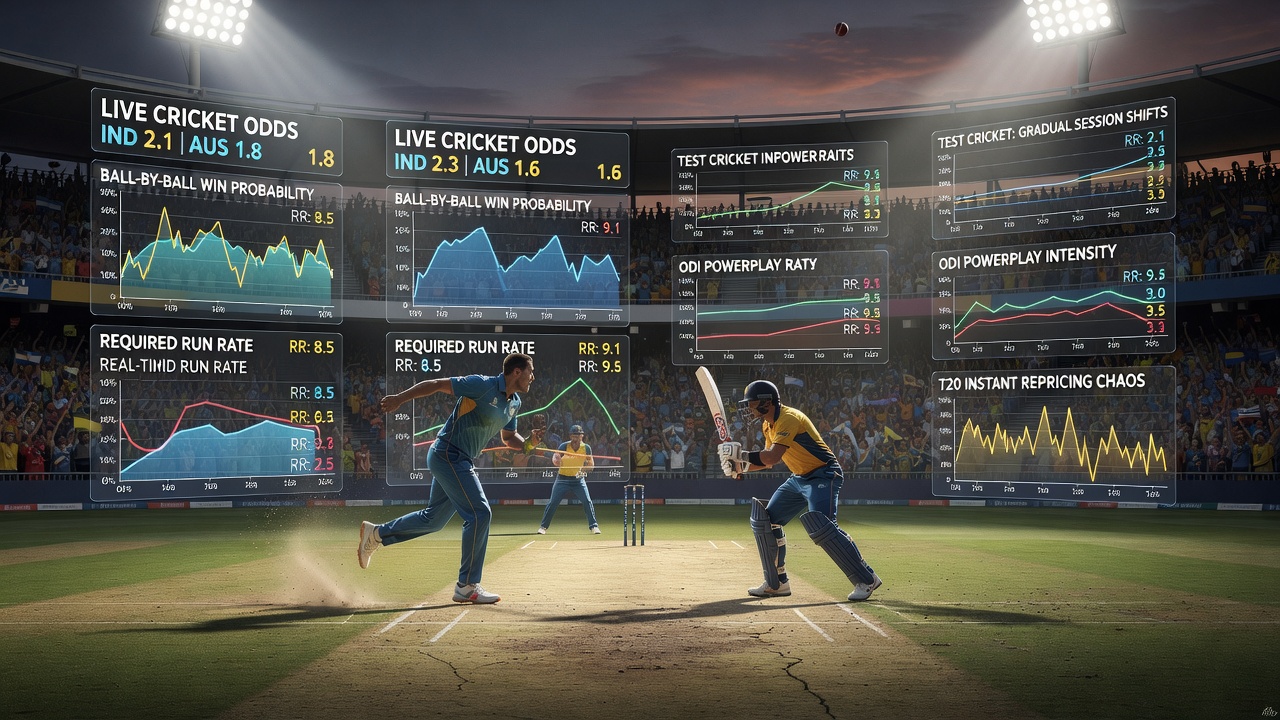
A single dot ball can swing a market by ten percent within seconds. That is the reality of modern cricket wagering, where prices shift with every delivery and a batsman's decision to defend rather than attack changes the mathematics of an entire innings. For anyone watching the numbers rather than just the scoreboard, this volatility is not chaos - it is opportunity, provided you know how to read it.
Cricket has become one of the most data-dense sports to follow in real time. Every over generates new information: run rate, required rate, wicket probability, pitch behavior, and momentum shifts that ripple through live cricket odds almost instantly. Bookmakers recalculate constantly, and the gap between a price at the start of an over and its value six balls later can be substantial. Platforms offering live cricket betting have built entire interfaces around this rhythm, letting bettors react to a boundary or a run-out the moment it happens rather than waiting for the next innings break.
This piece breaks down how live pricing actually works, how to read match predictions without falling for noise, and where today's sharpest betting tips come from. Whether you follow Test cricket's slow tension or T20's compressed drama, understanding the mechanics behind the numbers will change how you watch the game.
Understanding Live Cricket Odds
How Odds Are Calculated in Real Time
Odds providers run continuous models that weigh current score, wickets in hand, required run rate, and historical scoring patterns for similar match situations. When a team needs forty runs off thirty balls with six wickets standing, the model treats that very differently than the same target with two wickets left. Every ball updates these inputs, which is why prices move even during quiet passages of play - the model is quietly recalculating probability with each delivery bowled.
Why Prices Shift Mid-Over
A single boundary can move live cricket odds by several points because it simultaneously increases the batting side's projected total and reduces the bowling side's win probability. Conversely, a dot ball under pressure tightens the equation for the chasing team. This is the core reason in-play markets feel faster and more reactive than pre-match lines - there is no waiting for a full innings to complete before the numbers adjust.
Reading Odds Across Formats: Test, ODI, T20
Format matters enormously. In Test cricket, odds move gradually across sessions because there's time for recovery. In T20s, a single over can flip a match's win probability entirely, since twenty-four runs in three balls is a realistic outcome. ODIs sit between the two, with odds shifting meaningfully during power-play overs and the death-overs phase near the innings' end.
- Test cricket: gradual shifts tied to session performance and pitch wear
- ODI cricket: sharper moves during power plays and final ten overs
- T20 cricket: near-instant repricing after boundaries or wickets
Live Cricket Match Predictions: What They Actually Tell You
Data Models vs Expert Analysis
Statistical models process historical data, current form, and situational variables to produce a probability. Expert analysis adds context a model can't easily quantify - a bowler carrying a niggle, a pitch that's started turning more than expected, or a batting order reshuffled due to weather delay. The strongest live cricket match predictions combine both: numbers for the baseline, human judgment for the exceptions.
Pitch, Weather, and Toss Impact on Predictions
Pitch condition remains the single biggest variable analysts weigh before adjusting a prediction. A dry, cracked surface favors spin and shifts predicted totals downward. Overcast skies help swing bowlers early, which is why toss-winning captains at grounds known for green tops almost always choose to bowl first. These factors get baked into predictions before a ball is bowled, then recalibrated as actual conditions reveal themselves.
Common Mistakes When Interpreting Predictions
Treating a prediction as a certainty rather than a probability is the most frequent error. A model showing sixty-five percent win probability for one side still means the other side wins more than a third of the time. Bettors also tend to overreact to a single spectacular over, ignoring that momentum in cricket rarely sustains without supporting conditions.
Cricket Betting Tips Today: Building a Smarter Approach
Pre-Match Research Checklist
Before placing any wager, a disciplined bettor checks team news, pitch report, head-to-head record at the specific venue, and recent form across the last five matches rather than the full season. Squad changes matter more than league standing - a key bowler's absence can swing a match's character entirely.
- Confirmed playing XI and any late injury substitutions
- Venue-specific batting and bowling averages
- Recent head-to-head results between the two sides
- Weather forecast affecting toss decisions and swing conditions
Spotting Value in Cricket Betting Tips Today Listings
Not every published tip carries equal weight. Value exists when the offered price is more generous than the actual probability of the outcome. If a team's realistic win chance is fifty-five percent but the market prices it at even money, that gap represents value worth acting on - regardless of how popular the opposing tip might be that day.
Bankroll Management for In-Play Betting
In-play markets tempt bettors into chasing losses after a bad session, particularly during T20 run chases where odds swing dramatically. Setting a fixed stake per bet and refusing to increase it after a loss protects against the emotional decisions that erode a bankroll faster than any single wrong prediction.
Ball by Ball Live Cricket Betting Explained
How In-Play Markets Update Each Delivery
Ball by ball live cricket betting markets recalculate after every legal delivery - and sometimes after wides or no-balls too, since these affect both run tally and over count. A well-timed bet placed just before a bowler starts their run-up can capture better value than waiting for the outcome, provided you've read the situation correctly.
Popular Micro-Markets: Next Ball, Next Over, Next Wicket
Beyond match-winner and total-runs markets, ball-level betting includes wagers on whether the next delivery produces a boundary, whether the over concludes with a wicket, or which bowler will concede the most runs in their spell. These micro-markets demand faster decision-making and closer attention to bowling changes and field placements.
Speed and Timing Advantages in Ball-by-Ball Formats
Latency matters here more than almost anywhere else in sports betting. A few seconds' delay between the actual delivery and the odds update can mean the difference between capturing value and betting into a price that's already moved. Experienced bettors watch the live feed and the odds panel simultaneously, reacting to field changes before the ball is even bowled.
Tracking Cricket Live Score and Betting Together
Why Score Tracking Improves Betting Decisions
Cricket live score and betting are inseparable in practice - a bettor who only watches the odds panel without following actual match context is working with half the picture. Knowing that a set batsman has just reached fifty, for instance, tells you something about acceleration potential that the raw number alone won't reveal.
Best Practices for Following Multiple Matches Simultaneously
During tournament windows with overlapping fixtures, disciplined bettors prioritize one match for active betting and use secondary screens purely for score awareness. Splitting full attention across three live matches typically degrades decision quality in all of them.
Tools and Dashboards for Real-Time Tracking
Modern betting platforms integrate score feeds directly alongside odds panels, removing the need to switch between separate apps. This integration reduces the reaction gap between seeing a wicket fall and adjusting your next move, which matters considerably in fast-moving T20 contexts.
Choosing a Reliable Platform for Live Cricket Betting
Licensing, Security, and Payout Speed
A platform's licensing jurisdiction indicates the regulatory standards it operates under, which directly affects fund security and dispute resolution. Payout speed is equally telling - platforms that delay withdrawals without clear explanation should raise immediate concern regardless of how attractive their odds appear.
Market Depth and Coverage of Domestic vs International Cricket
Not every platform covers domestic T20 leagues or lower-tier ODI series with the same depth as marquee international fixtures. Bettors who follow niche competitions need to verify market availability before assuming coverage extends beyond the major tournaments.
Mobile Experience for Ball-by-Ball Wagering
Given how fast in-play markets move, a platform's mobile responsiveness becomes a functional requirement rather than a convenience. Lag during app refresh directly translates into missed value or delayed bet confirmation during critical overs.
Frequently Asked Questions
How often do live cricket odds actually change during a match?
Odds typically update after every legal delivery, and sometimes after extras like wides or no-balls. During high-tension phases such as death overs in a T20 chase, prices can shift several times within a single over as wickets, boundaries, and dot balls each carry weight.
Are live match predictions more reliable than pre-match ones?
Live predictions incorporate real conditions - actual pitch behavior, current form on the day, and momentum - so they generally reflect the match state more accurately than pre-match forecasts built purely on historical data. However, they still represent probability, not certainty, and can swing quickly with a single over.
What's the difference between match-winner odds and ball-by-ball markets?
Match-winner odds predict the overall result of the game, while ball-by-ball markets focus on individual delivery outcomes like whether a boundary is scored or a wicket falls on the next ball. The latter requires much faster reaction time and closer attention to in-game context like field placement and bowler fatigue.
Can weather conditions really change a prediction significantly?
Yes. Overcast conditions assist seam and swing bowling, often reducing predicted first-innings totals, while dry conditions later in a match tend to favor spinners as the pitch wears. Toss decisions are frequently made specifically around these expected shifts.
How do I avoid getting misled by inflated cricket betting tips today?
Cross-check any tip against actual team news, venue history, and current form rather than accepting it at face value. A tip is only useful if it identifies genuine value between the suggested outcome and the price offered - popularity of a tip has no bearing on its accuracy.
Is it possible to bet effectively without watching the match live?
It's considerably harder. Ball-by-ball markets depend on real-time context - field placements, bowler body language, pitch wear - that a scorecard alone doesn't convey. Bettors who skip live viewing typically rely on pre-match markets instead, which move slower and offer less opportunity for value capture.