
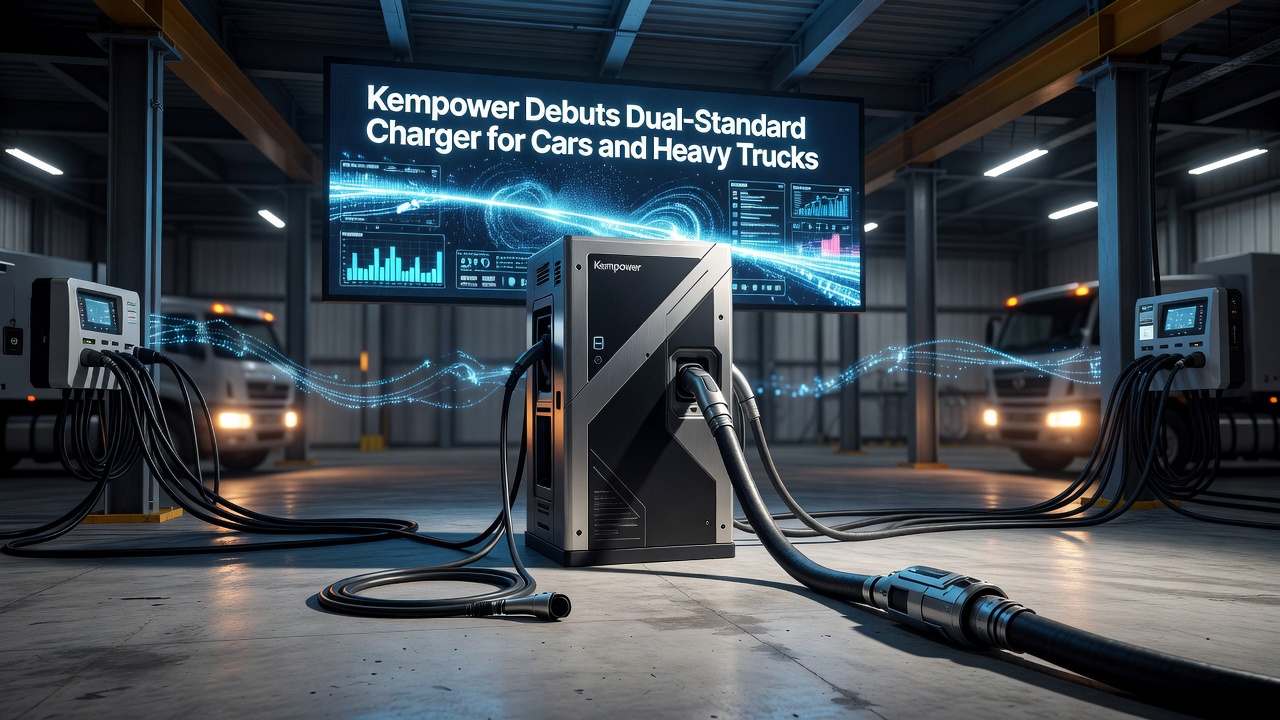
Kempower has introduced a single charging unit capable of serving both passenger electric vehicles and heavy-duty electric trucks, a design choice that could reshape how charging sites are planned in the coming years. The new Mega Satellite Flex supports the widely used CCS standard at up to 560 kW and the emerging Megawatt Charging System at up to 1.2 MW, making it the company's first dispenser built to handle either format. It was unveiled this week at the Unplug & Recharge event held alongside ACT Expo, where the unit is on public display.
The timing reflects a broader inflection point in electric transport. CCS has been the default connector for passenger EVs for years, but it was never engineered for the power demands of long-haul trucking, where drivers need to add hundreds of kilometers of range during a short mandated rest stop. MCS was developed specifically to close that gap, delivering power in a different order of magnitude. Until now, operators building a charging site had to essentially choose a lane, or build twice. Kempower's pitch is that a single piece of hardware can now serve both audiences from the outset, which matters enormously for site planners weighing land costs, grid connection fees, and construction timelines. For fleet managers or charge point operators researching which hardware and network options suit their routes, comparing providers online, including a service you can test first, has become as routine as comparing charging speeds. a service you can test first
Why One Box for Two Standards Matters
Building charging infrastructure is capital-intensive, and the biggest risk for any operator is guessing wrong about future demand. A site built only for passenger cars cannot easily absorb a fleet of electric semis later without a second construction project, additional grid capacity, and new permitting. By supporting both CCS and MCS through one dispenser, Kempower is effectively selling insurance against that uncertainty. The unit also accommodates 800-volt vehicle architectures, an increasingly common design in newer EVs that allows for faster charging without excessive heat buildup in the cables, since higher voltage reduces the current needed to deliver the same power.
Technical Specifications and Practical Trade-offs
The Mega Satellite Flex is rated for up to 1,500 amps on the MCS side and 700 amps for CCS, with cable lengths of 5 meters for CCS and 2.7 meters for MCS. The shorter MCS cable reflects the physical realities of high-current connectors, which require heavier, more rigid cabling that is harder to extend without adding weight and cost. An optional payment terminal is available, letting operators run the unit as a public-access point rather than a private fleet asset. It also integrates with Kempower's existing distributed charging architecture, meaning operators already running Kempower hardware can add the new dispenser without redesigning their power distribution systems.
What Comes Next
The Mega Satellite Flex is scheduled to reach the North American and European markets in July 2026, giving operators a runway to plan sites around its arrival. Its real test will be commercial: whether fleet operators, truck stop owners, and highway charging networks find enough value in combined-standard hardware to justify the premium over single-standard units. Given how unevenly MCS infrastructure has been deployed so far, a charger that hedges against both outcomes may prove decisive for operators unwilling to bet the site on one connector type.