
How to Run a Goal Review, Project Review, Performance Review, Quarterly Review, and Strategic Review Effectively
Most organizations run reviews on autopilot. A calendar reminder fires, a meeting gets booked, someone pulls up last quarter's slides, and the same conversation repeats itself with slightly different numbers. The result is a ritual that consumes hours without producing decisions. That gap between activity and outcome is the actual problem worth solving, not the format of the meeting itself.
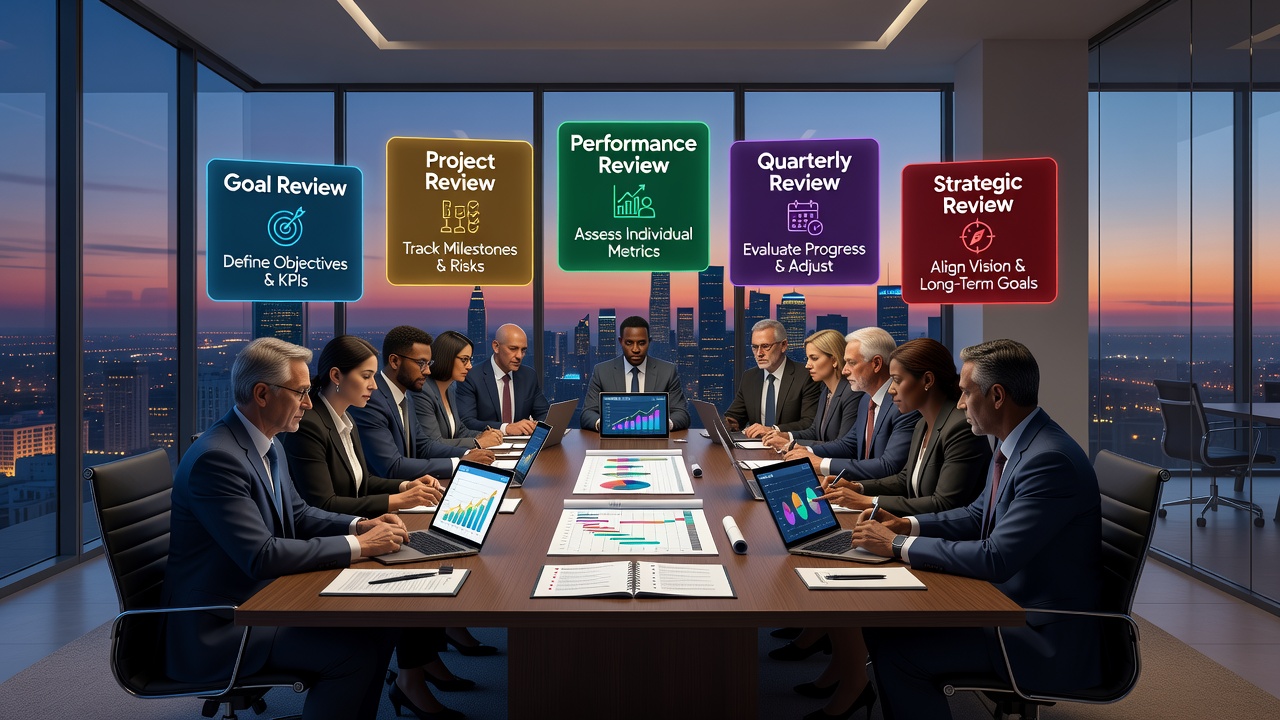
Five distinct review types exist for five distinct reasons, and treating them as interchangeable is where most teams go wrong. A goal review checks whether specific targets are on track. A project review examines execution mechanics. A performance review evaluates individual contribution. A quarterly review steps back to assess the business at a cadence wide enough to see patterns. A strategic review questions whether the direction itself still makes sense. For teams looking to sharpen their approach through structured practice, a goal review can even be modeled on the disciplined feedback loops used in goal review simulations, where every round forces a clear read on what worked and what didn't before moving forward.
This piece breaks down each review type on its own terms, then shows how they connect into a single operating rhythm. The aim is not more meetings. It's fewer, sharper ones that actually change what happens next.
Understanding the Five Types of Reviews and Their Purpose
Before running any review well, it helps to know precisely what each one is built to answer. Conflating them is the single most common cause of wasted meeting time - teams end up discussing performance in a strategic review or debating strategy in a project review, and neither conversation lands.
Goal Review: Tracking Progress Against Specific Targets
A goal review answers one narrow question: are we on pace to hit what we said we'd hit? It is quantitative by nature. Good goal reviews compare current status against a baseline and a deadline, then identify the gap. They work best when goals are specific enough to measure - vague goals produce vague reviews, and vague reviews produce no action.
Project Review: Assessing Execution and Delivery
A project review looks at how work is actually being done - scope, timeline, resourcing, and risk. It's less about whether the destination is right and more about whether the path there is holding up. Delays, budget overruns, and scope creep surface here before they become goal-level failures.
Performance Review: Evaluating Individual Contribution
A performance review is personal. It assesses an individual's output, growth, and behavior against expectations set for their role. Mixing this with team-level project discussion tends to make people defensive rather than reflective, which undermines the entire point of the exercise.
Quarterly Review and Strategic Review: Zooming Out
A quarterly review aggregates goal and project data into a business-wide snapshot at a fixed interval. A strategic review goes further still, questioning whether the goals themselves remain the right ones. These two operate at altitude - they're where direction gets set or corrected, not where day-to-day execution gets managed.
- Goal review - measures progress against a defined target
- Project review - measures execution quality and delivery risk
- Performance review - measures individual contribution and growth
- Quarterly review - measures overall business health at a fixed cadence
- Strategic review - measures whether the current direction still holds
Preparing for a Review: The Foundation of Effectiveness
Every review's quality is decided before it starts. The meeting itself just surfaces what preparation did or didn't provide.
Gathering the Right Data in Advance
Whether it's a goal review or a quarterly review, data collected the morning of the meeting is almost always incomplete and skewed toward whatever's easiest to pull. Reviews improve dramatically when metrics are tracked continuously and simply compiled - not generated - for the session.
Setting a Clear Agenda and Time Boundaries
An open-ended review invites open-ended discussion, which invites drift. A tight agenda with allocated time per topic keeps a performance review from turning into a two-hour negotiation and keeps a strategic review from spiraling into philosophy.
Defining Who Needs to Be in the Room
A project review benefits from including people close to the work. A strategic review does not need the same attendee list - too many voices at the strategic level dilutes decision-making rather than improving it.
Running the Review: Structure and Facilitation
The meeting itself needs a shape. Without one, even well-prepared reviews collapse into status recitation.
Opening With Context, Not Just Numbers
Starting a quarterly review with a wall of metrics loses the room within minutes. A short framing of what changed since the last review - market shifts, team changes, external pressure - gives the numbers meaning before they're presented.
Separating Diagnosis From Decision-Making
Good facilitation keeps "what happened" distinct from "what we do about it." This matters most in a performance review, where jumping straight to consequences before fully understanding context damages trust.
Keeping Strategic Reviews Focused on Direction, Not Details
A strategic review that drifts into operational specifics loses its value entirely. The facilitator's job is to redirect tactical questions to a project review or goal review and keep the conversation at the level of assumptions and direction.
Turning Review Insights Into Action
A review that ends without assigned next steps was, functionally, a status update - not a review.
Documenting Decisions and Owners
Every conclusion from a goal review or project review needs a named owner and a date. Decisions without owners quietly evaporate between meetings.
Adjusting Goals or Plans Based on Findings
If a quarterly review reveals a target was unrealistic, the target should change - not just the excuse for missing it. Reviews exist to correct course, not to justify staying on a broken one.
Communicating Outcomes Beyond the Room
Findings from a strategic review or performance review rarely stay contained to attendees. Deciding in advance what gets shared, with whom, and how, prevents rumor from filling the gap left by silence.
Common Mistakes That Undermine Reviews
Certain patterns show up repeatedly across organizations, regardless of size or industry.
Treating Every Review as the Same Meeting
Running a performance review with the tone and structure of a project review confuses purpose and audience. Each type demands its own rhythm and level of candor.
Reviewing Too Late to Matter
A goal review conducted after the deadline has already passed is a postmortem, not a review. Timing has to allow for correction, not just reflection.
Skipping Follow-Through
The most consistent failure across goal review, project review, and strategic review practices alike is a strong meeting followed by zero tracked follow-up. The review becomes theater.
Building a Review Cadence That Fits Your Organization
Reviews work best as a connected system, not isolated events scattered across the calendar.
Aligning Frequency to Purpose
Goal reviews often work weekly or biweekly. Project reviews follow milestone cadence. Performance reviews suit a quarterly or biannual rhythm. Quarterly reviews are, unsurprisingly, quarterly. Strategic reviews typically happen once or twice a year - any more frequently and direction never has time to prove itself right or wrong.
Connecting the Levels Into One System
Goal reviews feed into quarterly reviews. Quarterly reviews feed into strategic reviews. When this chain is intact, a strategic review is grounded in real data rather than opinion, and a goal review feels connected to something larger than a single metric.
Frequently Asked Questions
How long should a typical review meeting last?
A goal review or project review usually fits in 30 to 45 minutes if data is prepared in advance. Performance reviews and strategic reviews need more room - often 60 to 90 minutes - because they involve judgment and discussion, not just status reporting.
Who should lead a performance review versus a strategic review?
A performance review is typically led by a direct manager who has firsthand context on the individual's work. A strategic review is better led by a senior leader or founder, since it requires authority to actually change direction, not just discuss it.
What's the biggest sign that a review process isn't working?
If the same issues appear meeting after meeting with no resolution, the review is diagnosing problems but not driving action. That's a follow-through failure, not a discussion failure.
Can quarterly reviews and strategic reviews happen in the same session?
They can, but it's rarely ideal. A quarterly review is grounded in recent performance data, while a strategic review requires distance from recent results to judge direction fairly. Combining them risks recent wins or losses overly influencing long-term decisions.
How do you keep a goal review from becoming a blame session?
Frame the review around the gap between target and outcome, not around who is responsible for the gap. Once the data is on the table, shift immediately to what adjustment is needed rather than dwelling on cause.
Should remote teams run these reviews differently?
The structure stays the same, but remote reviews benefit from sharing data and agendas well before the meeting, since informal hallway context that fills gaps in person doesn't exist online. Written summaries after the meeting also matter more when teams aren't co-located.